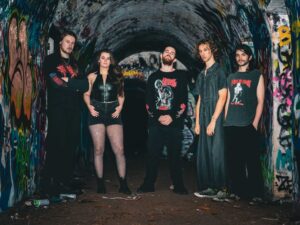
With their latest single “Bestial Hunger,” Destruction of the Healer are stepping into a more ferocious and unrelenting chapter, sharpening their sound while holding tight to the melodic roots that define them. As the first glimpse into their upcoming full-length
A Universe Bereaved,the track signals a band pushing its own boundaries, both technically and creatively, while staying grounded in raw, uncompromising death metal. We caught up with the band to talk about this evolution, the ideas driving their new material, and what listeners can expect from this next era.
1.
“Bestial Hunger” feels like a turning point, was there a specific moment where you realised the band was heading in a heavier direction?
A: This is the first single to feature songwriting by our bassist Darby Ball, who combined our previously Gothenburg melodic death metal sound with some influence from more brutal American bands such as undeath and cannibal corpse. The track and the album to come is still melodeath at heart but with some added grit and brutality.
2. How did adding a second guitarist change the way you approach writing and arranging songs?
A: Gwyneth joining the band has given us the freedom to write more technical and intricate guitar parts without needing to worry about the playability of said parts while singing at the same time. Now both guitarists and vocals can perform at full capacity without compromise.
3. The new material leans into both precision and chaos, how do you strike that balance without losing intensity?
A: Darby and I approach songwriting very deliberately. We know when to push into blast beats and aggression, and when to pull back into melody or space. The balance comes from strong dynamics. When one element becomes complex, another is simplified to keep everything impactful.
4. There’s a strong sense of brutality in the new single, how much of that is driven by concept versus purely musical direction?
A: The lyrics always follow what the music suggests. When Darby brought in “Bestial Hunger, ” it immediately evoked something violent and primal. It’s probably our most Cannibal Corpse-esque track, so the concept followed naturally.
5. With the upcoming album “A Universe Bereaved,” does “Bestial Hunger” reflect the overall direction of the record, or can listeners expect it to take different turns and explore a wider range of sounds and ideas?
A: While overall, “A Universe Bereaved” is our heaviest release to date, it is also a very dynamic album overall, dipping into a wide range of metal subgenres. Listeners can expect tracks that are more brutal than ‘Bestial’, conventional melodeath, and evenblackened and atmospheric death as well.
6. Do you approach songwriting differently when building a track meant to feel atmospheric versus one that’s more direct and aggressive?
A: To a degree, but most songs start from a single idea and grow from there. Darby and I both build on that initial concept. The atmospheric tracks tend to have more separation between instruments and more experimentation, including symphonic elements. The heavier tracks are more tightly locked in and rhythm focused.
7. Your sound blends melodic death metal with more extreme elements, do you see yourselves leaning further into one side, or continuing to blur those lines?
A: It depends on who is writing the song. Darby tends to write brutal death metal with a touch of melodeath, whereas I write melodic death metal with a touch of brutal death. That contrast has become part of our identity, and we’ll likely continue working that way.
8. How important is storytelling or imagery when you’re writing heavier, more technical material?
A: It’s essential. I write lyrics to reflect the imagery the music creates.“Bestial Hunger” is one of the more direct tracks conceptually, but I still aim to use strong imagery and literary devices across everything.
9. The band has a strong reputation for live performance, how do you translate such dense, technical songs onto the stage?
A: We push ourselves technically, but everything is written to be performed live without reliance on backing tracks. There are extra layers in the recordings, but the core of thesongs holds up on stage without them.
10. Having handled much of the recording and production yourselves, what were the biggest challenges, and advantages, of keeping it in-house?
A: The biggest challenge was time and the learning curve, especially with mixing. The advantage is full creative control and flexibility. We weren’t rushed, so we could focus ongetting the best performances rather than relying on overproduction.
11. You’ve all got ties to different parts of the music and creative industries, how does that wider experience influence the band’s identity?
A: Darby and Ethan both have a background in jazz music. Ethan’s drum beats often incorporate rhythms, grooves and fills inspired by latin and jazz drumming in a metal concept. Darby’s knowledge of jazz harmony has allowed us to keep our music as melodic death metal but explore new textures, harmonies and progressions.
12. The Australian metal scene seems to be evolving, where do you see your band fitting within it right now?
A: The Australian scene seems to be growing in popularity and we’re all stoked to be part of a scene where there’s so much love for the music and respect amongst bands.
Our sound is a bit more niche than the current trend of hardcore/deathcore/metalcore bands. We’re rooted in raw 90s melodic and brutal death metal. But I like to think this gives us our own distinct identity and helps us stand out in the contemporary heavy music scene
13. Looking ahead, what do you want listeners to take away from this new era of Destruction of the Healer?
A: I want listeners to take away an appreciation of rawness and authenticity. Particularly in this day and age of AI generated art and stale, clinically perfect modern metal production. This album is imperfect by design, it is a showcase of our ability as artists and musicians without pretence.
