Photo credit: Daniel Boud
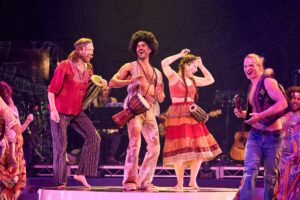
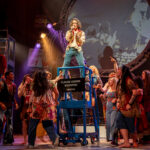
Set against the Vietnam War and the seismic social shifts of the late 1960s, HAIR follows a bohemian tribe of politically active, long-haired hippies in New York City. United in their rejection of war, conformity, and repression, they champion a world of peace, free love, and radical self-expression.
Jackson McGovern is an award-winning actor who works in theatre and film. Originally trained in drama and musical theatre, he also works extensively with young artists for Queensland Theatre Company, La Boite, Grin and Tonic, Complete Works, Shake and Stir, and many other companies throughout Australia as a teaching artist, director and adjudicator. Jackson is currently starring as Woof in the Sydney production of Hair: The Tribal Rock Musical, and we caught up with him to discuss his role in this fantastic production.
You’ve played everything from Shakespearean heroes and villains to musical theatre roles and contemporary characters. What was it about Hair and the role of Woof that made you want to be part of this production?
I’ve loved Hair since I first got to know it when I was training at the QLD Conservatorium. It has a message and a spirit that are both so relevant and still somehow necessary today, despite all of the things we think we’ve learnt from history. Yes, it’s very much about the hippie movement of the 60s, but the parallels between the youth of those days and the youth of now crying out for change are quite profound. Woof really represents a lot of the fun side of that movement, which is a joy to play. And I get to sing a song about taboo sexual practices in the first ten minutes, so that’s also quite fun.
Woof is often seen as one of the most open-hearted and free-spirited members of the Tribe. How have you approached bringing him to life, and what aspects of his personality resonate most with you?
His open heart and free spirit are definitely there, and our director Glenn Elston gave me a lot of freedom in the room to roam around the stage during many of the tribe scenes. Woof dances very much to his own beat, but ultimately I think just wants to love and be loved and be fully accepted by a community. I think we can all relate to that on some level. He is also a Catholic, and struggles to reconcile his genuine faith with the things that faith has told him he shouldn’t do. Not necessarily in a religious way, but that duality also resonates with me a fair bit. Two things that are a core part of someone’s identity at odds
Hair was considered revolutionary when it premiered, tackling topics that many productions wouldn’t touch at the time. Why do you think audiences continue to connect with it more than 50 years later?
I mean, how far have we really come? We still have world leaders starting conflicts fueled as much by ego, power and money as anything else; we still have gross inequality between certain demographics in society; we still have people freaking out about gender norms and the way we express ourselves in our appearance. Young people have met me at stage door after shows and have wondered how this show was written in the 60s, because they connected so strongly to a lot of the issues it raised. Add to that the joy it brings watching people who saw the original production almost 60 years ago tearfully dancing in the aisles, and you can see that these aren’t just songs to them – they are absolute anthems. As an actor, it’s a privilege to play just a small role in taking those people back to such a special time in their lives, and sharing that with them.
The show is deeply rooted in the anti-war and counterculture movements of the 1960s. As someone performing it in 2026, what parallels do you see between that era and the world young people are navigating today?
I’ve already touched on a few of these, because it’s almost impossible not to. Young people are still crying out for most of the things Hair cried out for in 1968. Outside of what’s already been said (and yes, the “don’t get too political in an interview, Jackson” part of my brain has been in overdrive), the generation gap is a big standout for me. And weirdly, it’s probably the issue in Hair I’m most OK with allowing to stay. I think we can learn a little bit from Hair as to how we communicate between generations on political issues that matter to those respective generations. There are some great moments in Hair that remind us that we really do all mostly want the same things for the world, regardless of age, cultural background, gender identity, whatever.
You’ve performed in productions ranging from Macbeth and The Crucible to Death of a Salesman. How does the energy and audience experience of Hair differ from some of those more traditional works?
I always think theatre is just conversation with an audience, and they are always the ultimate ingredient in any production. I started off my career doing theatre in education through Brisbane and regional QLD with Grin and Tonic, and I remember doing the Romeo and Juliet balcony scene with so many cheers and boos that it felt like a football game. And that energy really does feed you as a performer. Hair feels like that times 1,000. Right from the outset, the audience is basically welcomed into the tribe. It’s like they’re our best friends for the next two and a half hours rather than people just sitting watching a show. If you’re someone who doesn’t like audience participation, don’t stress: you’re not getting up to dance in the aisles (unless you want to, in which case I’ll meet you there). But you will feel part of the tribe experience. And that togetherness is uniquely special about this show. No two nights are the same.
One of the most talked-about moments in Hair is the famous nude scene. What conversations have you and the cast had about its symbolism, and why is that moment still important within the story?
Interestingly, we haven’t had huge discussions about it. I’ve been in rehearsal rooms where this would have taken days of table chat about metaphors, symbols and lots of other words I generally don’t care about. We certainly had small conversations around its meaning, and obviously around making sure everyone is comfortable with the logistics of it all, which is all handled very professionally by the team. But when it all comes down to it, I think it’s quite a simple message, but one that can mean something slightly different to everyone in it or watching it. To me, it’s about a group of people expressing, “This is who I am.” I love hearing from audience members what they think as well though.
The original Australian production of Hair faced censorship, police scrutiny, and obscenity charges. Does knowing that history change the way you approach performing the show today?
I don’t know if it changes the way I approach performing it, but it certainly makes me tip my hat to those artists who faced that and paved the way for us to do it more freely. I have enormous respect for them, and any artists before us who have really paved the path in so many ways. Yeah, we can be pessimistic about the lack of progress we’ve made in some of the things I’ve already mentioned (reminder to self to not get too political), and those things should continue to be spoken about and fought against, but the very fact we can do this piece of theatre now without the same risk of cops charging the theatre because a few genitals are on show really does show that we can actually create change by pushing those boundaries. There is hope.
You’ve spent a significant part of your career mentoring and teaching young performers. What lessons from Hair—about identity, individuality, and finding your voice—do you think are particularly valuable for emerging artists?
I always encourage students to find their own way of doing things. Yes, listen to teachers, and try all sorts of methods and techniques to enhance your craft. But we are all unique, and that uniqueness is the best thing about every single one of us. Yeah, that’s a pretty core principle in Hair, but even outside the piece itself, just looking around at my castmates I can see such a diverse field of talents and approaches to the work, and none are better or worst than another. We have people from more acting backgrounds, some who are more singers, some more dancers, some even who are doing their first ever theatre show. But what everyone has is their own unique energy and talents. You don’t need to do it the same way.
The music of Hair has become iconic, with songs like ‘Aquarius’ and ‘Let the Sunshine In’ recognised across generations. Is there a particular number in the show that gives you goosebumps either as a performer or as an audience member?
There are so many bangers it’s hard to pick. What a Piece of Work is Man is stunning. Let the Sunshine In is probably the most well known song from the show, and within the context of the play is actually quite harrowing to me. And Three-Five-Zero-Zero is gut-wrenching. I don’t want to harp on about it too much, but if you’re not familiar, come see the show then look up its backstory. Musically, it slaps, but it also makes you feel uncomfortable at what I think is a perfect time in the show to feel uncomfortable.
After audiences leave the theatre, what do you hope stays with them most—the music, the nostalgia, the political themes, or something else entirely?
I want everyone to leave with something different, to be honest. For a new theatregoer, a great time and a little bit of provocation. For a rusted on MT fan…the same thing, I guess, so maybe I lied. (Plus maybe an appreciation for the performances, the design, the music, which I think are all pretty top notch). For the eighty-year-old for whom five versions of Hair are the only times they’ve set foot in a theatre, maybe nostalgia and a bit of hope that us young’uns now (although, I barely fall into that category anymore) are still pushing for change like their generation did. Although hopefully that’s not necessary for too much longer…
With its iconic rock score (“Aquarius,” “Let the Sunshine In,” “I Got Life,” and “Good Morning Starshine”), HAIR broke ground by blending rock music with raw emotion, political commentary, and boundary-pushing storytelling. This production honours the original trailblazers, keeping the soul of HAIR alive while inviting audiences to rediscover the power, poetry, and passion of one of theatre’s most revolutionary works.
HAIR THE MUSICAL
Book and Lyrics by Gerome Ragni and James Rado
Music by Galt MacDermot
Directed by Glenn Elston OAM
Choreography by Sue-Ellen Shook
Venue: Theatre Royal Sydney, 108 King St, Sydney
Dates: From 6 June
Price: From $69* (*plus handling fee of $9.50)
Times: Tue – 6:30pm, Wed to Sat – 7:30pm, Wed and Sun – 1:00pm and Sat – 2:00pm.
Tickets: www.hairthemusical.com.au
